
When men smelled like roses: How culture, not nature, divided fragrances into “masculine” and “feminine”
Walk into any modern perfume store and you’ll see a world neatly split in two. On the left — dark, minimalistic bottles with moss, woods, and leather meant for men. On the right — delicate pink or golden bottles with jasmine, vanilla, and fruity notes meant for women. We tend to assume this division is dictated by nature itself. As if the male nose is biologically tuned to “strong” scents, and the female nose to “soft” ones.
But the history of olfactory culture tells a different story: in the world of scent, there is no biological gender. What we call a “masculine scent” today is a relatively recent invention — the result of social changes, political ideas, and marketing strategies of the past two centuries. Let’s dive into history to understand when men stopped smelling like flowers and why essential oils today help us dismantle these stereotypes.
The Era of Olfactory Freedom
If we traveled to France or England in the 18th century, our modern noses would be shocked. At that time, scent was a marker of status, not gender. A wealthy nobleman and his wife smelled almost identical. Preferences were shaped by fashion and the cost of ingredients, not by sex.
Men generously used violet-scented powder and wore gloves infused with amber and musk. A vivid example is Louis XIV, the “Sun King,” later known as “the sweetest king” (le doux fleurant). His favorites — orange blossom (neroli), tuberose, jasmine, and spices — would be classified today as “ultra-feminine.” Yet back then, a lush floral trail was a sign of power, wealth, and divine proximity. Flowers meant luxury, and a man of power was expected to smell luxurious.
Even Napoleon Bonaparte, the symbol of military might, used liters of Eau de Cologne every month — with bright notes of rosemary, citrus, and neroli. For him, it was a scent of hygiene and vitality, completely free of any “feminine” associations.
The Great Masculine Renunciation
The 19th century changed everything. With the rise of the Industrial Revolution and the emerging bourgeois class, Europe underwent a cultural shift that British psychologist J.C. Flügel called “The Great Masculine Renunciation.” The new male ideal — factory owners, bankers, politicians — wanted to distance themselves from the aristocracy with its wigs, silk, and floral perfumes.
Aristocratic elegance became associated with laziness and decadence. The new man was meant to be rational, restrained, functional, and serious.
How did this affect scent? The olfactory world was radically censored. Complex, sensual, floral compositions were assigned to women. Women remained the “ornament” of society — therefore they were expected to smell like flowers. Men became the “doers.” Their scent palette narrowed to soap-cleanliness, tobacco, and leather. Anything more expressive risked being perceived as frivolous or unprofessional.
1882: The Birth of the “Masculine” Scent
Still, men wanted to wear fragrance. The market needed something pleasant that wouldn’t be associated with a woman’s boudoir. The solution came from a laboratory.
In 1882, the house of Houbigant released Fougère Royale — a revolutionary fragrance. Perfumer Paul Parquet created an accord that didn’t exist in nature (since ferns barely have a smell). He blended synthetic coumarin (smelling of fresh hay) with lavender and oakmoss.
The result was abstract, fresh, woody, and “clean.” It became the prototype of the fougère family. Fougères quickly became the standard for barbershops and aftershaves. That’s how lavender and moss became anchored in collective memory as the smell of a “well-groomed man.”
Throughout the 20th century, marketing deepened the divide:
• Wood and spice = strength, stability, adventure (for him)
• Flowers and fruit = emotion, seduction, softness (for her)
Returning to Nature: Essential Oils Beyond Gender
In the 21st century, we finally begin to see how artificial these borders are. And here aromatherapy steps forward — essential oils and hydrolates. Plants have no gender bias.
Rose (Rosa damascena): not a “feminine” scent. For centuries, Sufi mystics — men — used it for meditation and heart-opening practices. Its chemistry calms the nervous system of any human being.
Vetiver and cedar: not “masculine ruggedness.” They are roots and woods that bring grounding and stability. Modern women need them just as much as men.
Lavender: a universal relaxant that doesn’t choose whose sleep to improve.
The philosophy of our brand is rooted in returning to the functionality and natural essence of aroma. We offer hydrolates and oils chosen not by stereotypes or label color, but by what your body and soul genuinely need.
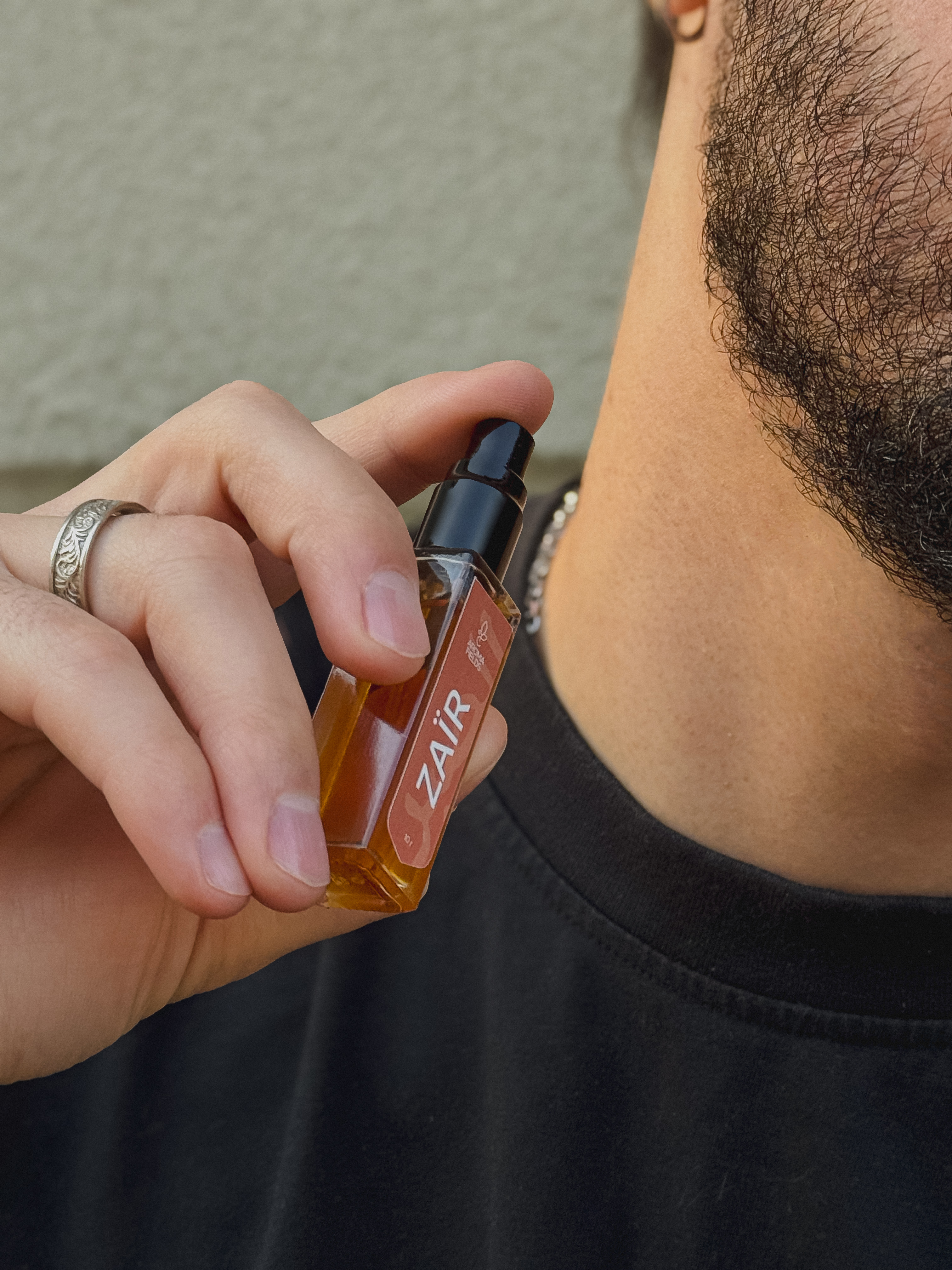
These same principles guided us in creating our 100% plant-based unisex perfume Zaїr, crafted from essential oils and absolutes. It has no gender. No boundaries.
Conclusion: Trust Your Nose, Not the Marketing
The history of perfumery proves: the division into “masculine” and “feminine” is just a game we collectively agreed to play about 200 years ago. And now, the rules are changing.
Real freedom means choosing an orange blossom note if you need lightness — even if you’re a man. Or reaching for deep, woody cedar if you’re a woman seeking focus and determination. Nature created scents for everyone.
Allow yourself the luxury of choosing what resonates with you.